Ask any classical dancer who has spent more than a decade on the floor about their body, and you will hear a familiar catalog of physical compromises: chronic tightness across the sacroiliac joint, dull patellar aches after a two-hour Varnam rehearsal, and stiff Achilles tendons every morning.
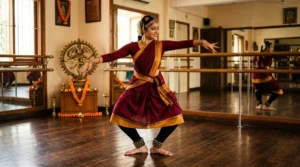
Indian classical dance—whether Bharatanatyam, Kathak, Kuchipudi, or Odissi—is an intensely athletic endeavor. In Bharatanatyam, the foundational Aramandi (half-seated demi-plié) requires external hip rotation while driving maximum percussive force into the floor through repetitive Thattadavus. In Kathak, the torque of thirty rapid chakkars (spins) demands instantaneous rotational deceleration on bare feet.
Historically, dancers have relied on passive stretching and pure repetition. When joint fatigue sets in, the common advice was to simply push through. Today, leading performance academies and movement therapists have turned to an ancient native antidote: Kalaripayattu, the martial art of Kerala, and specifically its foundational body-conditioning discipline, Meipayattu.
1. The Biomechanics of Aramandi Strain
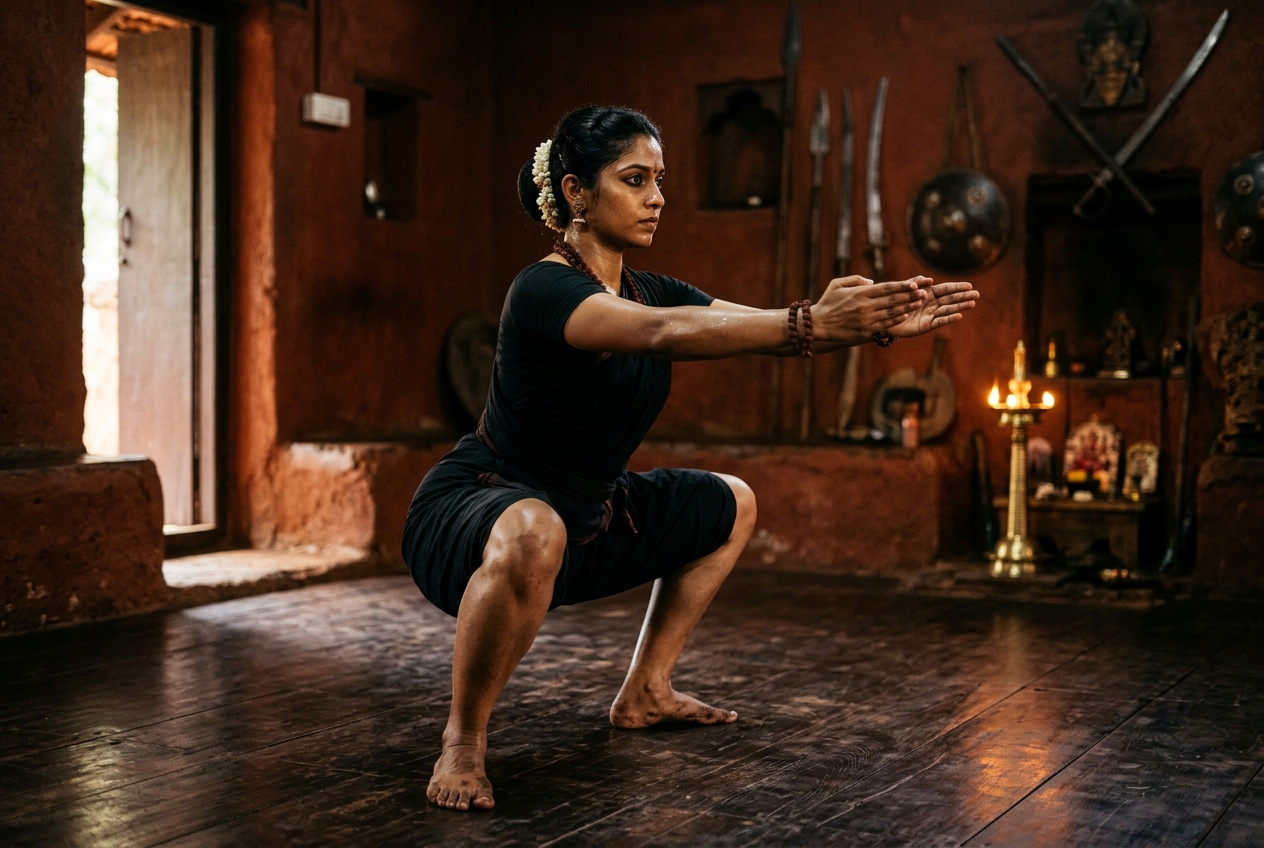
When a dancer’s deep external rotators (the piriformis and gluteus medius) fatigue, the knees naturally collapse inward during Aramandi. Instead of being absorbed by the large muscles of the hip and thigh, sheer rotational stress transfers directly into the medial collateral ligament (MCL) and patellar tendon.
Over years of practice, this unilateral load leads to:
- Patellofemoral Pain Syndrome (“Dancer’s Knee”)
- Plantar Fasciitis from unyielding heel strikes
- Lumbar lordosis and lower back spasms
Dancers frequently train in hip flexion and external rotation, but rarely condition the antagonist kinetic chain—explosive hip extension, lateral deceleration, and spinal core stability.
2. Meipayattu: Making the Body “All Eyes”
The guiding principle of Kalari conditioning is “Meyyu Kannakkuka”—literally, “to make the body an eye.” It cultivates a fluid, animal-like physical equilibrium where every joint shares the load.
Meipayattu consists of continuous movement sequences practiced barefoot close to the ground. Unlike modern weight training, which isolates single muscles in linear planes, Meipayattu conditions the entire myofascial network through three-dimensional spirals.
Here is how core Kalari animal postures (Ashta Vadivugal) directly reinforce dance technique:
- Gaja Vadivu (Elephant Stance) -> True Aramandi Hip Stability: In Gaja Vadivu, the student drops into an ultra-deep, wide squat with a tucked pelvis, erect spine, and grounded feet. It trains active hip abduction under full body weight, strengthening the gluteus medius so knees never cave inward during rapid jathis.
- Simha Vadivu (Lion Stance) -> Achilles Resilience: A dynamic forward lunge with deep ankle dorsiflexion. It actively lengthens the calf muscles (gastrocnemius and soleus) while strengthening the front shin, preventing Achilles stiffness after heavy footwork.
- Ashwa Vadivu (Horse Stance) -> Neutral Pelvic Alignment: A deep forward-reaching posture that opens tight hip flexors and prevents anterior pelvic tilt during high jumps (Kuditta Metadavu).
3. Kalari “Kals” vs. Ballet Kicks
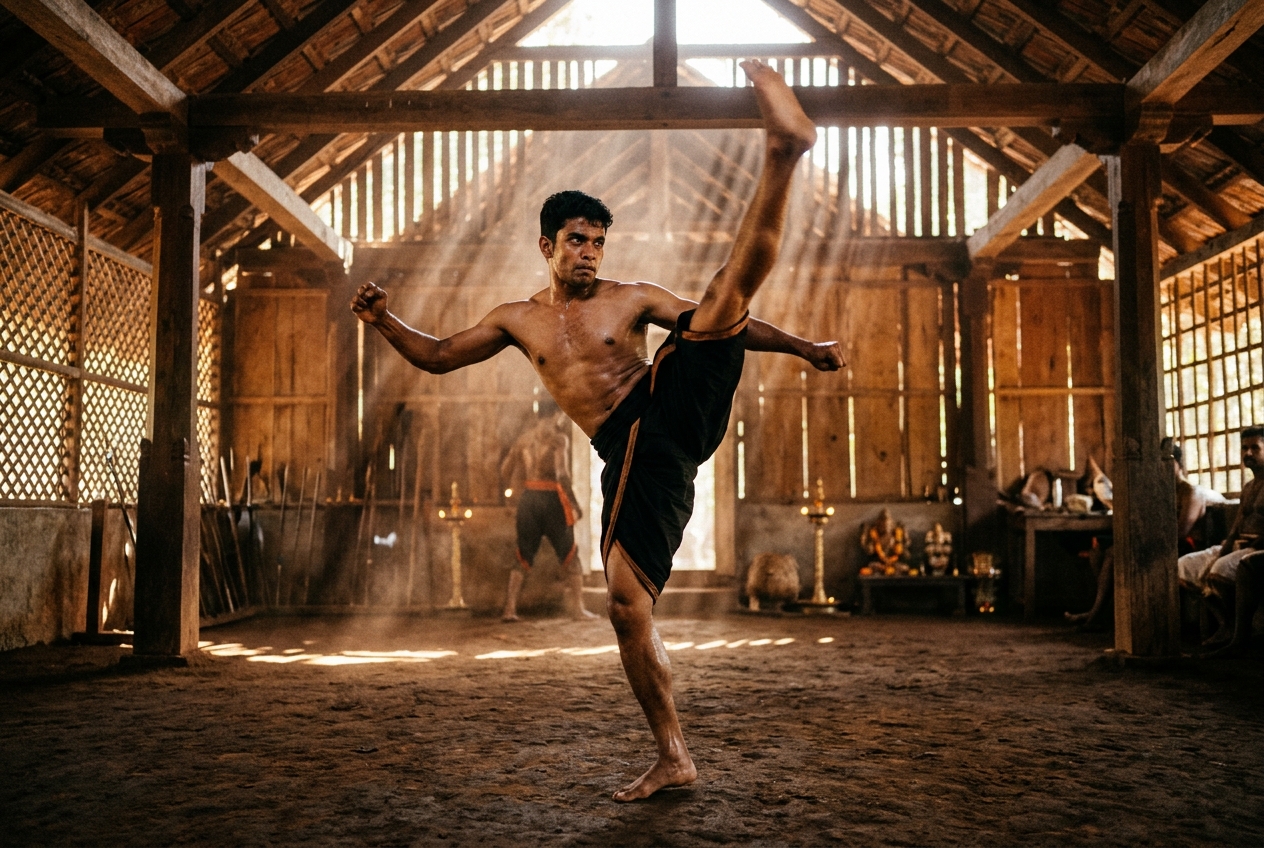
A cornerstone of Meipayattu is the practice of Kals (dynamic leg swings). Unlike a Western dance kick that emphasizes height and hip hyperextension, a Kalari leg swing is a weapon of functional kinetic control:
- Nere Kal (Straight Kick): The leg swings upward toward the forehead like a whip while the standing foot remains rooted. It dynamically elongates the hamstrings with zero compressive strain on the lumbar spine.
- Veethu Kal (Circular Sweeping Kick): The leg sweeps a wide 360-degree arc around the body, forcing core obliques to maintain vertical spine alignment against centrifugal momentum.
- Kon Kal (Angular Lateral Kick): Strengthens inner adductors and groin stabilizers, teaching dancers to decelerate high-speed movement cleanly without twisting the knee.
Crucially, every Kalari leg swing finishes with a soft, controlled toe-to-heel ground landing—training the exact neuromuscular deceleration needed to land classical dance leaps safely.
4. 15-Minute Daily Pre-Dance Kalari Protocol
Integrating Kalari conditioning does not mean abandoning your classical routine. Adding this simple 15-minute routine before tying your bells builds an active muscular armor around your joints:
Always practice this routine barefoot on a natural wooden or earthen floor. Avoid cushioned gym shoes, which disconnect your foot’s proprioceptive nerve endings from the ground.
5. Unified Arts at Kailasa Kaladhara
At Kailasa Kaladhara, we believe Natya, Yoga, and Kalaripayattu are complementary branches of the same sacred physical science.
In our HSR Layout studios in South Bangalore, classical dance students regularly cross-train with our martial arts faculty. By combining the emotional subtlety of classical dance with the grounded power of Kalaripayattu, our dancers develop performance longevity, explosive stamina, and freedom from joint pain.
Interested in exploring how martial arts conditioning can elevate your dance practice and protect your joints? Discover our Kalaripayattu & Martial Arts Classes or book an exploratory session at Kailasa Kaladhara Bangalore.