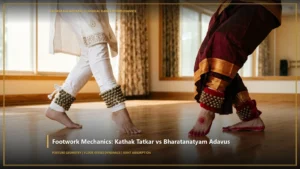
Close your eyes at an Indian classical dance festival, and you can instantly identify whether a dancer on stage practices Kathak or Bharatanatyam purely by the sound of their brass bells (ghungroos or salangai).
In Kathak, footwork creates a rapid, rolling murmur that sharpens into lightning-fast, crisp acoustic accents—like raindrops striking a temple roof before erupting into a synchronized thunderclap. In Bharatanatyam, footwork sounds like solid, resonant hammer-blows striking deep into the floorboards, grounding geometric bodily lines into sacred earth.
While both classical forms use the feet as rhythmic instruments, their underlying biomechanics, posture geometry, and impact distribution are completely different. Understanding how the lower kinetic chain functions in each style is essential for dancers who want speed, acoustic clarity, and lifelong joint health.
1. Postural Geometry: Upright Spring vs Grounded Demi-Plié
The foundation of foot mechanics begins at the spine and pelvis:
- Kathak (The Upright Axial Alignment): A Kathak dancer stands tall with an elongated spine, relaxed knees (samabhanga), and feet placed parallel or in a slight natural V-shape. The center of mass remains elevated and agile. The kinetic energy travels vertically through relaxed ankles, using the natural elasticity of the Achilles tendon like a micro-spring. This upright carriage allows dancers to transition effortlessly into whirlwind Kathak chakkars and rapid spins.
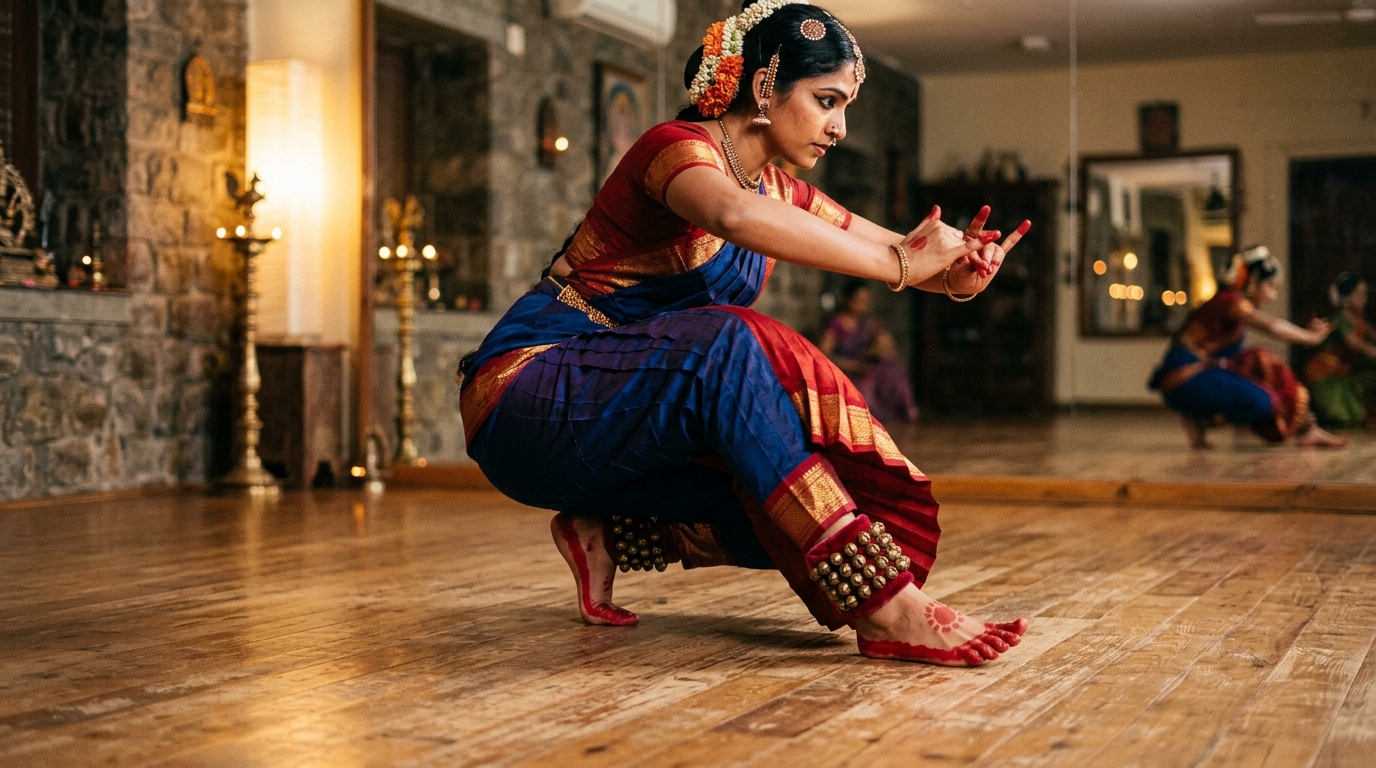
- Bharatanatyam (The Grounded Aramandi Triangle): A Bharatanatyam dancer operates primarily from Aramandi (or Ayatha), a deep demi-plié where the knees are turned out sideways at 180 degrees over outward-pointing heels. The pelvis is tucked, creating an equilateral triangular base between the navel and both knees. This wide, lowered base of support absorbs vertical kinetic forces horizontally across the quadriceps and adductors rather than dumping shock directly into the spinal discs.
| Biomechanical Parameter | Kathak Tatkar | Bharatanatyam Thattu Adavu |
|---|---|---|
| Primary Posture | Upright, vertical axis, relaxed knees | Deep demi-plié (Aramandi), turned-out hips |
| Foot Contact Point | Whole flat sole with spring-like ankle snap | Firm flat sole or sharp heel drop (nattu) |
| Knee Role | Shock micro-absorption; stays relatively straight | Continuous 90°–120° flexion acting as main shock absorber |
| Acoustic Focus | Rapid fractional subdivisions (layakari) | High-impact geometric resonance and rhythmic punctuation |
| Ghungroo Weight | 100 to 150 bells woven on thick rope cord | 40 to 60 heavier bells stitched on leather/velvet pads |
2. Floor Strike Dynamics: The Slap vs The Stamp
How does the foot actually meet the floor?
In Kathak’s basic footwork (Tatkar), the dancer executes rhythmic patterns (Ta-Thei-Thei-Tat) by lifting the foot barely two to three inches off the floor. The contact is an articulated slap: the entire flat sole contacts the stage simultaneously, with instantaneous relaxation upon impact. The knee never locks stiff; it acts as a subtle damper. Because the ankle remains supple, a dancer can articulate 16 micro-beats per second in fast drut laya without causing jarring shockwaves through the knees.
In Bharatanatyam’s foundational stamps (Thattu and Nattu Adavus), the foot is lifted decisively backward or upward from the hip, and driven down with intentional mass and kinetic authority (thatvalavu). In Kuditta Mettu adavus, the dancer jumps lightly onto the balls of both feet before slapping both heels down simultaneously.
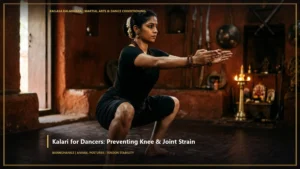
Because of the high impact of these stamps, dancer conditioning requires dedicated lower-body strengthening. Many dancers cross-train with Kalari animal postures to condition knees and tendons against joint stress.
3. Ghungroo Construction and Ankle Mechanics
The acoustic instrument worn around the ankle influences foot technique directly:
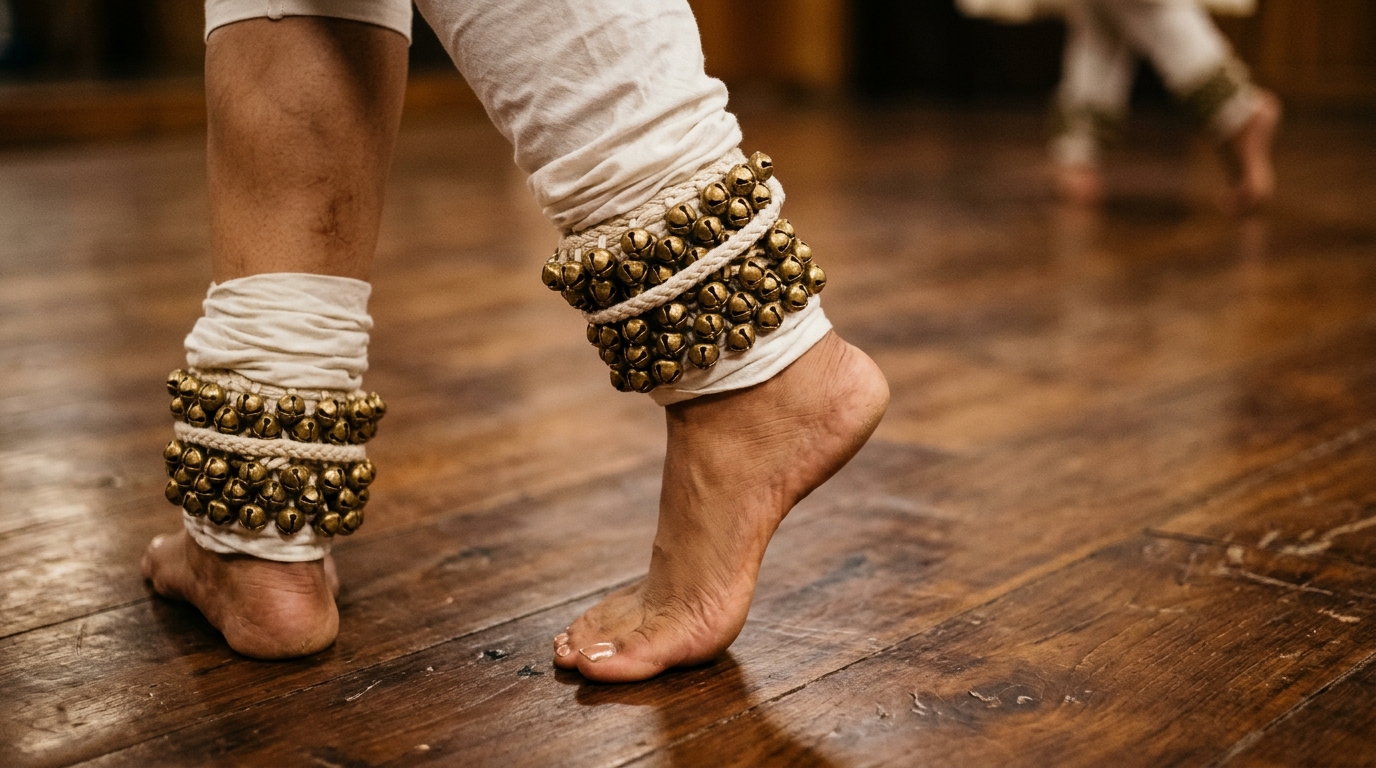
- Kathak Ghungroos: Dancers string between 100 and 150 lightweight brass bells along a continuous, thick cotton rope. The rope is wrapped dozens of times snugly around the lower calf and ankle joint. This continuous wrapping provides gentle, supportive compression to the ankle tendons, allowing subtle micro-movements to shake individual clusters of bells. Dancers choose and tie their bells following traditional ghungroo selection and tying methods.
- Bharatanatyam Salangai: Dancers wear 40 to 60 larger, heavier brass bells mounted on padded leather or cushioned velvet straps fastened with brass buckles. Because each bell is individually heavier, producing a clean, ringing tone requires a deliberate, forceful impact against the floor.
4. Protecting the Lower Limbs: Shin Splints and Floor Surfaces
Both dance styles place immense stress on the metatarsals, plantar fascia, and tibialis anterior muscles:
- Warm Up the Calf and Plantar Fascia: Never begin high-tempo Tatkar or vigorous Aramandi stamps cold. Spend 10 minutes rolling the soles of your feet over a firm ball and performing slow, controlled calf raises.
- Never Stamp on Bare Concrete or Tile: Practicing classical footwork on unyielding tile or concrete floors sends shockwaves straight up into your patellar tendon and lumbar spine, leading to shin splints and chronic knee inflammation.
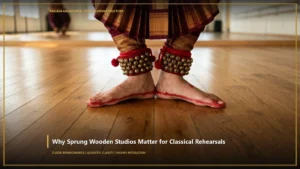
- Choose Dedicated Sprung Wooden Floors: Professional training demands floors built with shock-absorbing sub-layers that yield slightly under downward force, as explained in our analysis of why sprung wooden dance studios prevent injury.
Whether dancing the fluid, lightning-fast cadences of Lucknow Kathak or the rigorous, architectural stamps of Thanjavur Bharatanatyam, mastering the biomechanics of footwork transforms mechanical impact into transcendent, musical artistry.