Step into an introductory rhythm session at an Indian classical music academy, and you rarely see drums right away. Instead, a circle of young children sits cross-legged on floor mats. Their right palms tap firmly against their thighs, followed by deliberate finger counts: pinky, ring, middle. Simultaneously, their voices articulate crisp, percussive syllables with metronomic regularity:
“Tha — Ka — Dhi — Mi | Tha — Ka — Tha — Ki — Ta”
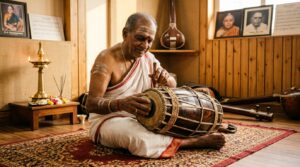
This is Konnakol—the vocal art of reciting Carnatic percussion syllables (solkattu). Long before a student strikes a mridangam skin or dances an intricate sequence of jathis, Konnakol provides the mental blueprint for time, symmetry, and subdivision.
While parents across South Bangalore’s tech corridors (HSR Layout, Sarjapur, and Bellandur) invest heavily in coding bootcamps and abacus classes, few realize that Carnatic music’s oral rhythm system is one of the most sophisticated neurological workouts ever devised.
1. Fractions Before Fractions: Intuitive Rhythmic Math
In primary school, introducing fractions can be dry and confusing. Dividing a single whole into thirds, fifths, or sevenths often feels abstract on two-dimensional worksheets.
In Konnakol, children grasp fractions physically and sonically years before encountering fraction notation on a blackboard.
Consider how Gatis (rhythmic subdivisions) operate inside a single steady pulse:
When a child executes an 8-beat Adi Tala cycle and shifts smoothly from Chatusra Nadai (32 micro-beats) into Tisra Nadai (24 micro-beats) without altering hand tempo, their brain performs modular arithmetic in real time. Mathematical division ceases to be an abstract formula; it becomes an embodied physical reality.
2. Bilateral Coordination and Neural Wiring
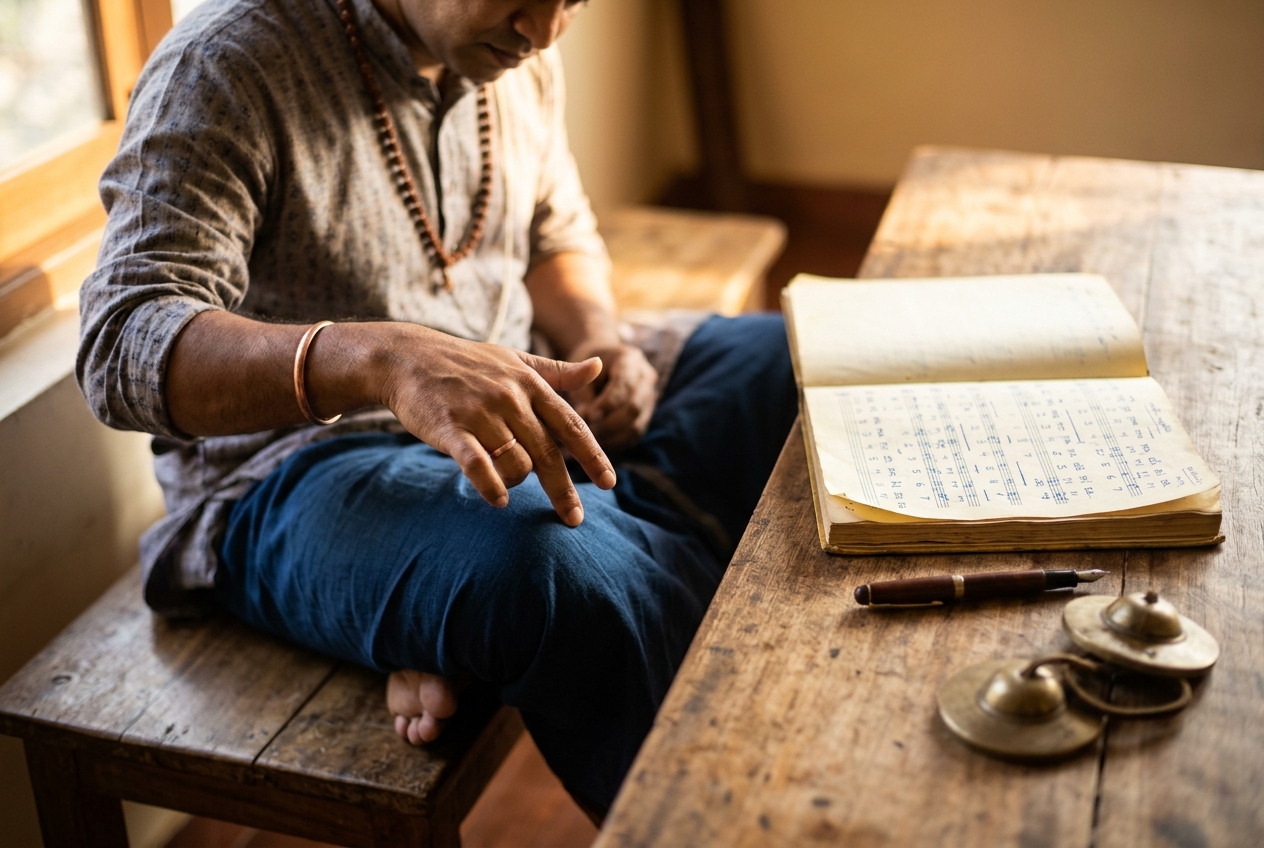
Cognitive development relies heavily on bilateral motor coordination—the ability of both cerebral hemispheres to govern simultaneous, asynchronous tasks.
Konnakol demands strict motor independence:
- The Fixed Clock (Hand Kriya): The right hand maintains an unyielding pulse. It drops on the thigh (ghata), waves outward (visarjita), or taps fingers sequentially. It represents an objective constant.
- The Dynamic Variable (Vocal Phrasing): While the hand maintains a steady tempo (e.g., 60 beats per minute), the vocal tract articulates poly-rhythms, syncopations, and rapid syllable clusters.
- Poorvangam: An opening rhythmic theme built with progressive numerical expansions (e.g., 3 + 4 + 5).
- Makutam: A concluding rhythmic crown repeated three identical times, calibrated so the final syllable lands squarely on the Samam (the first downbeat of the cycle).
- Articulatory Precision: Syllables like hard retroflex plosives (Ta, Tha), labials (Dhi, Mi), and dentals (Nam, Ki) demand active tongue-tip agility and diaphragmatic breath support. Children with speech hesitancy often develop crisp projection and clearer diction.
- Nervous System Grounding: The cyclical nature of Indian classical talas calms overstimulated nervous systems. Because talas are circular, missing a beat is never a dead end—it simply invites the child to breathe, reset, and rejoin on the next cycle.
If the hand hesitates when vocal phrases become dense, the rhythm collapses. To sustain both streams concurrently, the child’s prefrontal cortex must suppress reflexive imitation and cultivate executive motor control. This directly bolsters reading fluency, spatial reasoning, and sustained classroom focus.
3. Working Memory: The Architecture of a Korvai
Short-form digital media has noticeably fractured children’s attention spans. Konnakol directly counters this by training long-loop working memory through Korvais—structured mathematical rhythmic compositions.
A standard Korvai contains:
To recite a 32-beat Korvai, a child must retain multiple active variables in mental cache: their current location in the tala cycle, which repetition of the three-part makutam they are vocalizing, and the exact micro-rests (karvais) between phrases. A momentary lapse in focus means missing the downbeat. Mastering this teaches children sustained attention and the satisfaction of structural symmetry.
4. Phonetic Clarity and Calming Meter
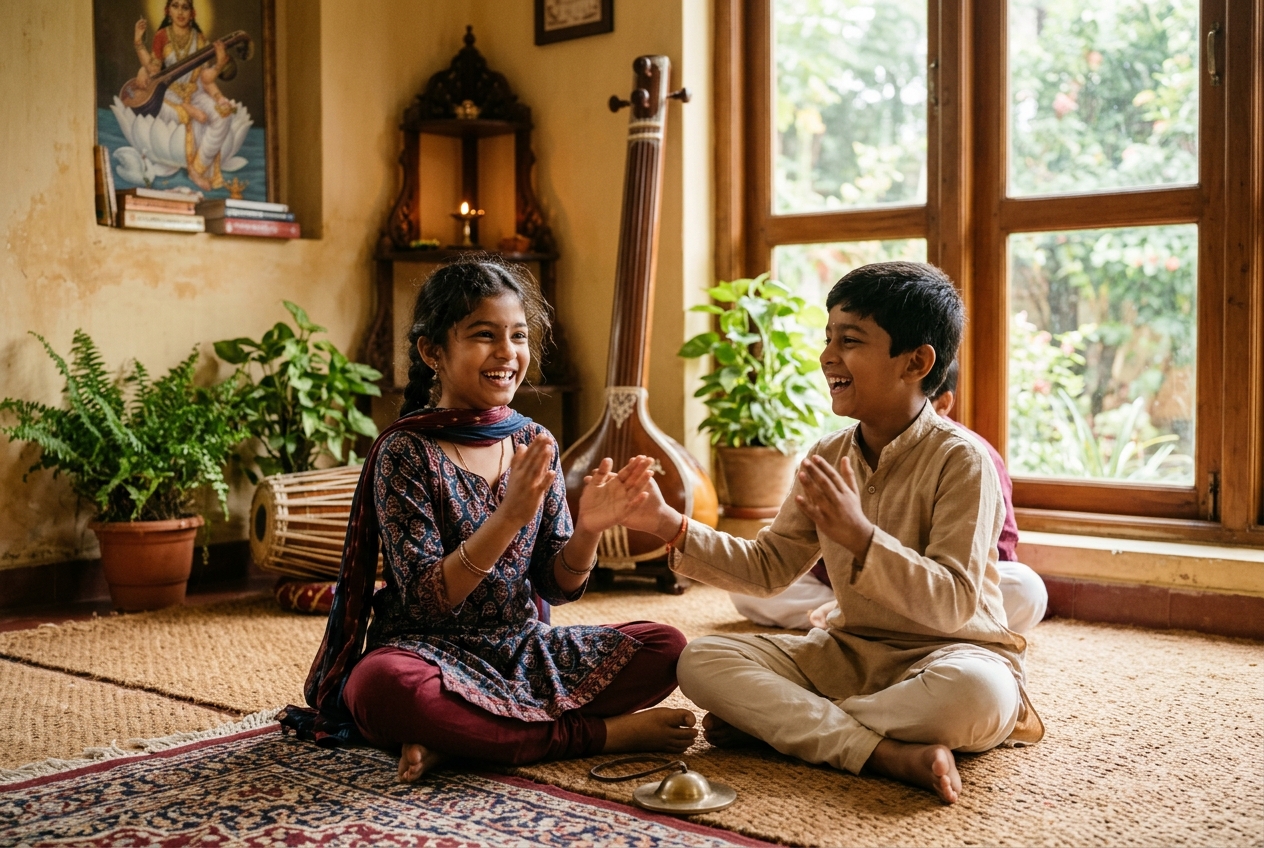
Beyond cognitive training, Konnakol provides valuable linguistic benefits:
5. Foundational Arts at Kailasa Kaladhara
At Kailasa Kaladhara, rhythm is never taught as mechanical drill work. In our Carnatic Vocal and Percussion Foundation classes in HSR Layout, spoken solkattu, rhythm games, and tala exercises are woven into foundational training from day one.
Whether your child aspires to learn the mridangam, master classical vocal music, or simply build sharp mental discipline for life, Konnakol provides an enduring intellectual and cultural foundation.
Curious how classical rhythm training can strengthen your child’s focus and musicality? Learn more about our Carnatic Music Classes in Bangalore or visit us at Kailasa Kaladhara HSR Layout.