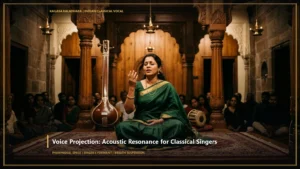
In modern concerts, microphones and sound monitors have become ubiquitous. Yet, any senior Carnatic guru will tell you that the true test of a classical singer is not how loud they can shout into a condenser mic, but how naturally their acoustic voice fills a high-ceilinged sabha hall or intimate temple courtyard without amplification.
For centuries before electrical public address systems existed, classical vocalists held audiences spellbound for four hours straight. They did not produce this power through throat tightness or vocal chord strain. Instead, they tapped into the timeless science of acoustic impedance matching—harnessing the body’s natural resonating chambers to amplify sound waves effortlessly.
Whether you sing Carnatic kritis or Hindustani khayals, learning how to project through resonance rather than muscle force preserves your vocal health for life.
1. The Trap of “Pushing from the Throat”
When young vocalists want more volume, their instinctive reaction is to push extra air through the vocal cords and squeeze the muscles of the larynx.
This creates three immediate problems:
- Vocal Cord Hyper-adduction: Forcing excessive subglottal pressure causes the vocal folds to slam together violently, leading to micro-tears, vocal nodules, and hoarseness.
- Formant Collapse: Constricting the throat closes off the pharynx, strangling upper harmonics. The voice sounds shrill, thin, and strained rather than rich and warm.
- Pitch Inaccuracy (Apaswaram): Laryngeal tension locks the vocal folds, making agile micro-tonal glides (gamakas) stiff and inaccurate.
True projection does not come from pushing harder; it comes from relaxing the throat while expanding the natural resonance cavities of your vocal tract. This distinction is at the heart of daily vocal care routines for Carnatic singers.
| Resonator Chamber | Physical Location | Sound Quality Produced | Practice Exercise |
|---|---|---|---|
| Chest (Uras) | Lower trachea & thoracic cage | Warm, authoritative low octaves (Mandra sthayi) | Sustained humming on lower Sa; deep chest vibration |
| Pharynx (Kantha) | Throat cavity behind tongue | Core body, vowel warmth, roundness | Open “Ah” with lowered larynx and relaxed jaw |
| Mask / Head (Shiras) | Nasopharynx, facial sinus mask | Piercing clarity, upper octaves (Tara sthayi) | Nasalized “Ngg” humming (Akaram transitions) |
2. Unlocking the “Singer’s Formant” Through Pharyngeal Space
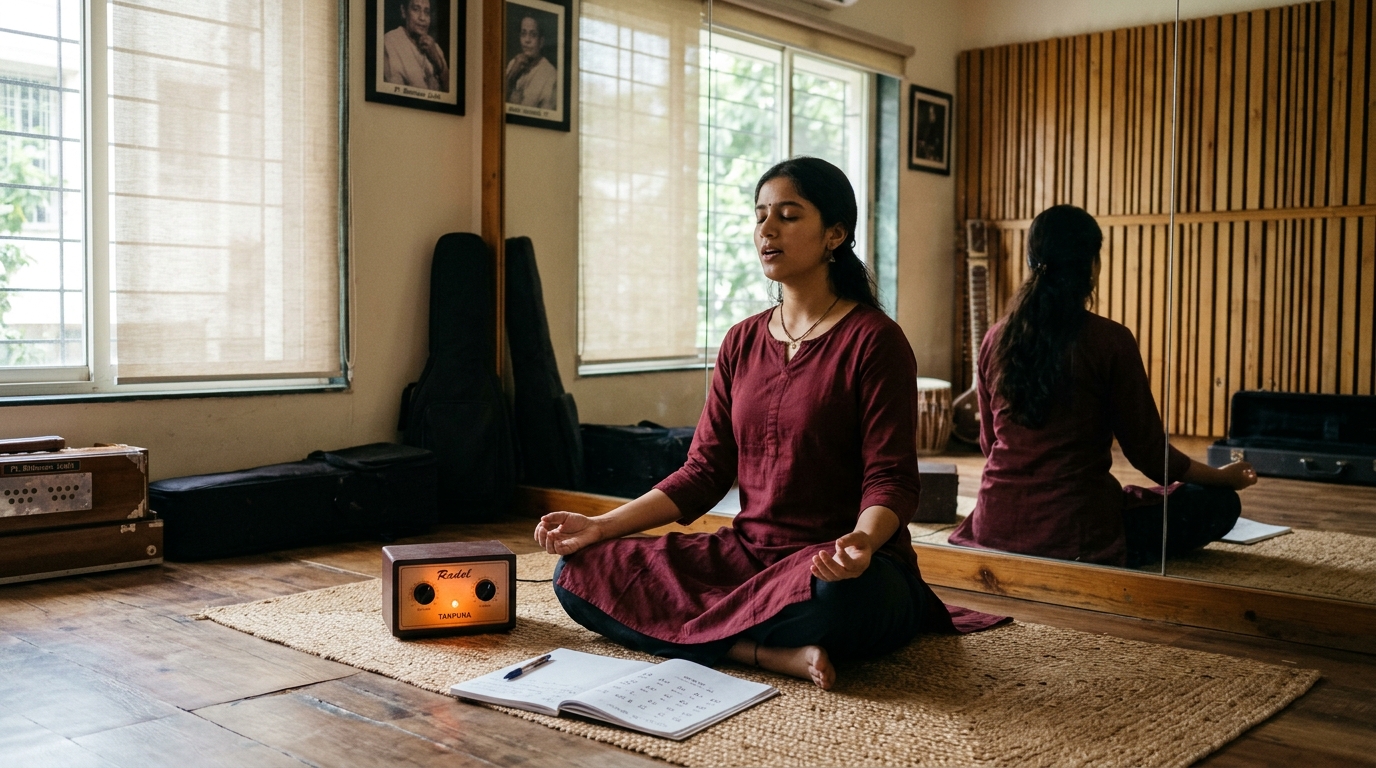
Acoustic physicists studying operatic and classical Indian vocalists have identified a key frequency cluster known as the Singer’s Formant (typically between 2,500 Hz and 3,200 Hz). When a singer aligns their vocal tract correctly, sound energy concentrates in this high-frequency band.
Because accompanying instruments like the mridangam, tanpura, and violin produce their primary acoustic energy below 2,000 Hz, a singer whose voice contains a strong singer’s formant can cut cleanly through a dense instrumental ensemble, even at conversational decibels.
To activate this acoustic sweet spot:
- The Inner Yawn: Inhale gently through your nose as if savoring the scent of fresh jasmine. Feel the soft palate (velum) rise and the back of your tongue drop naturally. This creates maximum volume inside the pharyngeal cavity.
- Release the Jaw Hinge: Never clamp your jaw or jut your chin forward. Allow the lower jaw to drop downward and slightly backward, freeing the base of the tongue from pressing against the vocal box.
- Focus Sound on the “Mask”: Direct the mental stream of vibration toward the triangular zone encompassing the bridge of your nose and cheekbones (chhaya resonance).
3. Breath Support (Prana Vayu) vs Breath Force
Projection requires air pressure, not air volume. If you dump too much air across the vocal folds, you blow them apart and produce a breathy, weak tone.
Classical singers rely on diaphragmatic appoggio—engaging the transverse abdominis, intercostal muscles, and pelvic floor to create steady, regulated air suspension. Deep breathing techniques taught in pranayama for singers and dancers train vocalists to anchor breath low in the belly, leaving the neck and shoulders completely loose.
A quick test: Place your palm gently against your throat while sustaining a high-octave note. If you feel the external neck muscles bulge or harden, you are straining. If your neck feels soft while your lower ribs expand outward, you are projecting with acoustic resonance.
4. The Mandra Sthayi Secret: Power from Below
Many singers mistakenly believe that projection training should focus on the high notes. In Indian classical tradition, the opposite is true.
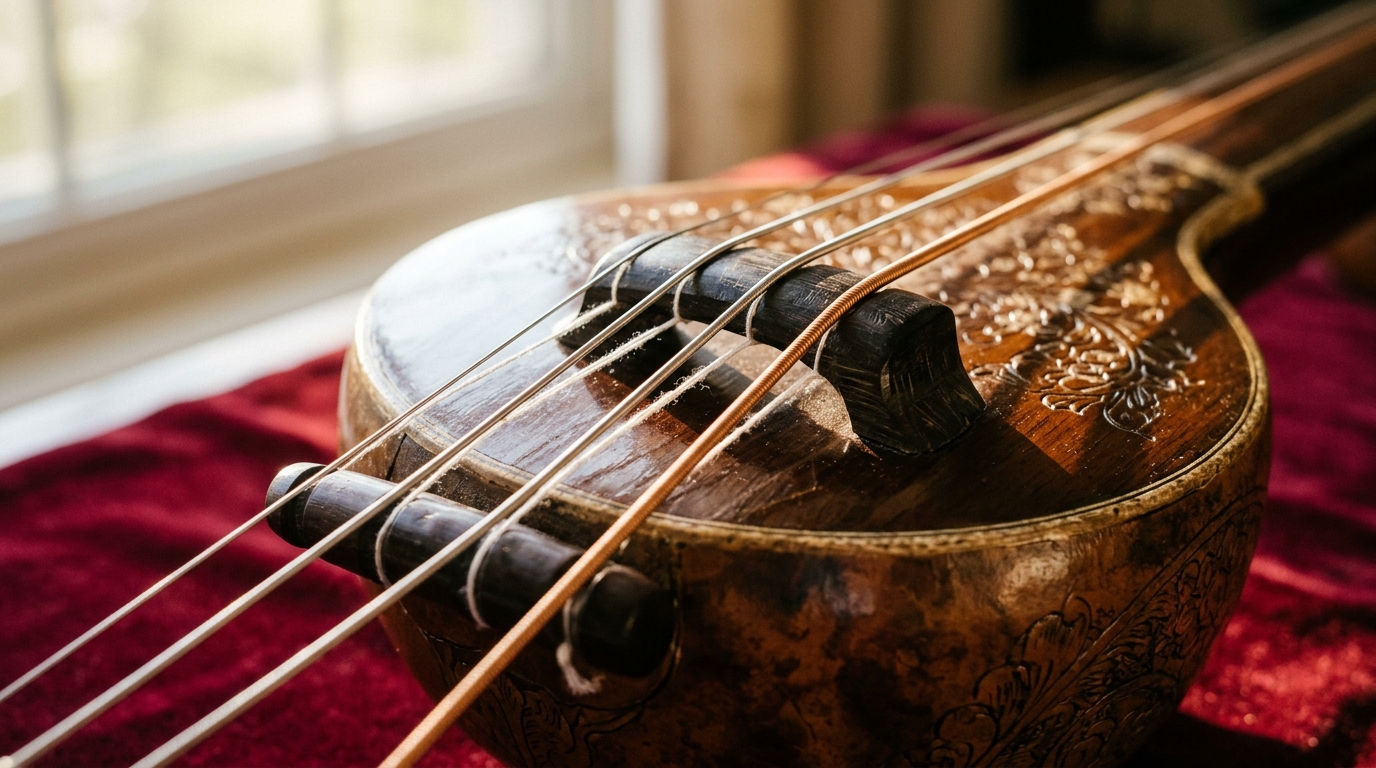
Master vocalists spend the first hour of every morning practice (Sadhana) in the Mandra Sthayi—the lower octave below Middle Sa. Practicing long, resonant sustained tones in the lower octave strengthens the thyroarytenoid muscles, balances vocal fold closure, and cultivates deep chest resonance. When your lower octave is solid, warm, and resonant, your upper octave (Tara Sthayi) naturally gains projection, brilliance, and ease without straining.
By understanding vocal acoustics, you step onto the stage not as a performer fighting a microphone, but as a master musician commanding space through the pure, effortless physics of sound.