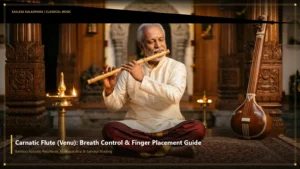
Among all the classical Indian instruments, few produce a sound as organically intimate, breath-infused, and soul-stirring as the South Indian bamboo flute—the Venu (or Pullanguzhal). Carved from seasoned red cedar or Assam bamboo with no mechanical reeds, keys, or valves, every single note, microtonal inflection (gamaka), and octave leap is generated purely through the player’s lip aperture, air column velocity, and nuanced finger shading.
For music aspirants in Bangalore searching for carnatic flute classes in bangalore, embarking on this instrumental journey requires systematic instruction in acoustic breath mechanics, embouchure geometry, and classical raga phrasing.
At Kailasa Kaladhara School of Performing Arts, our classical instrumental wing offers structured Carnatic flute training for beginners, children, and adult music lovers across our South Bangalore branches.
1. The Anatomy of the Carnatic Venu vs Western Flute
Understanding the physical construction of the classical Indian bamboo flute highlights its unique expressive capability:
- Natural Bamboo Resonance: Unlike metal orchestral transverse flutes that produce uniform tempered pitch, seasoned organic bamboo possesses subtle acoustic grain variations that impart warmth and rich natural harmonics (swaras).
- Eight-Hole Finger Configuration: The South Indian Carnatic flute traditionally features eight finger holes (compared to the six-hole North Indian Hindustani Bansuri), offering microtonal versatility across two and a half octaves.
- Absence of Mechanical Keys: The player’s bare finger pads directly cover and partially uncover the holes, allowing continuous glides (meend / nokku) that mirror the subtleties of the human singing voice.
Feature                        Carnatic Venu (Pullanguzhal)           Western Classical Flute
-------------------------------------------------------------------------------------------------
Construction Material          Natural Seasoned Bamboo                Silver / Nickel / Gold Metal
Key Mechanism                  None (Direct Finger Pad Shading)       Complex Padded Mechanical Keys
Tonal Pitch System             Just Intonation (Raga Microtones)      Equal Temperament (Fixed Pitches)
Ornamentation Style            Fluid Gamakas, Kampitha & Nokku        Vibrato & Trills
Seated Posture                 Padmasana / Cross-legged on floor      Standing or Straight Chair Seated
Blowing Hole (Embouchure)      Round Oval Blow Hole (Mukharandhra)    Lip Plate with Chimney
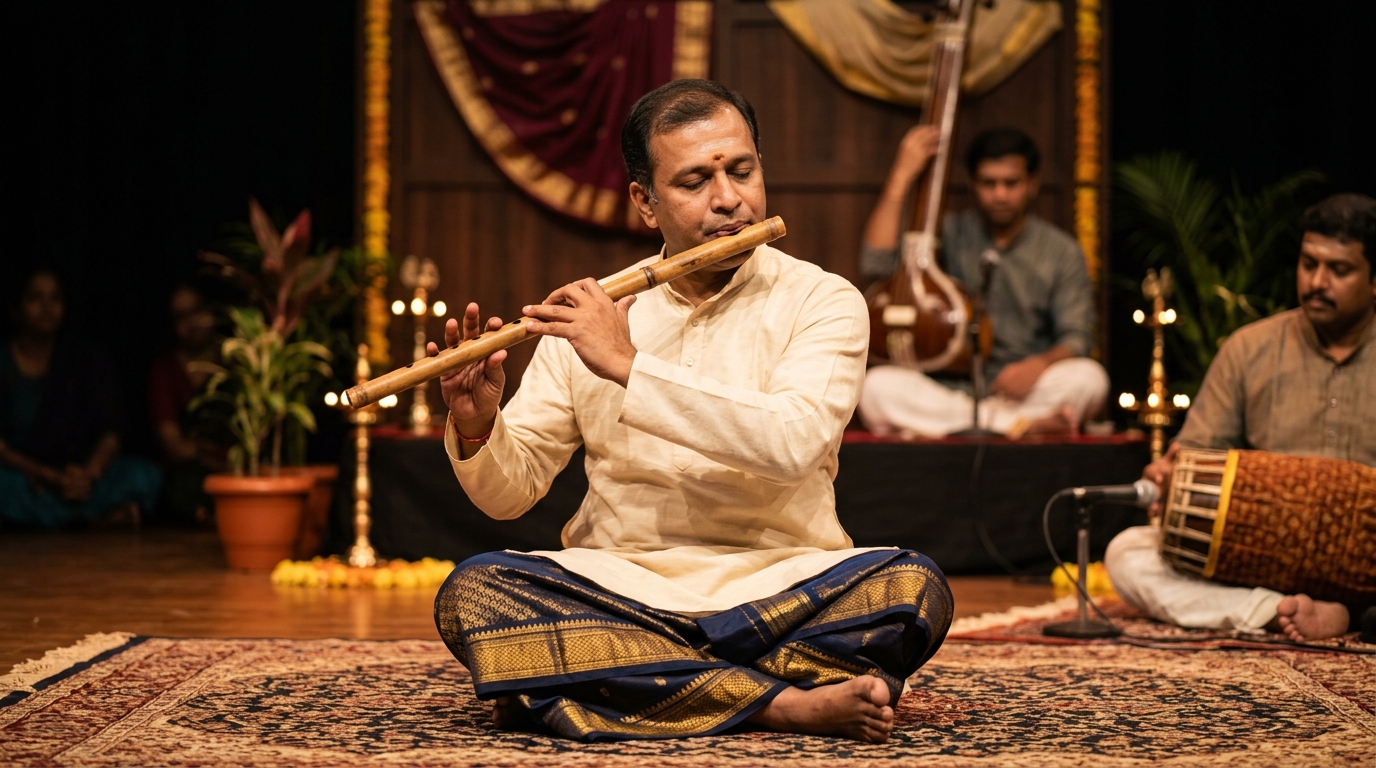
2. Mastering the Embouchure: The Science of Tone Production
The earliest obstacle beginner flute students encounter is producing a clean, sustained tone without breathiness or dizziness. In Carnatic pedagogy, this involves refining the Mukharandhra (blowing hole) interface:
1. Lower Lip Placement: The inner edge of the blow hole rests gently along the boundary of the lower lip’s red vermilion border, covering approximately one-third of the circular opening.
2. Aperture Compression: The lips do not purse into an exaggerated whistle; rather, the corners of the mouth pull back slightly while the center forms a narrow, focused horizontal slit.
3. Downward Air Angle: The focused jet of exhaled air strikes the opposite sharp outer edge of the hole at an angle of roughly 45 degrees, splitting the air stream to initiate high-velocity acoustic oscillation within the bamboo tube.
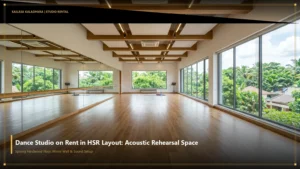
Beginners who practice on shock-absorbent, quiet acoustic rehearsal studio spaces learn to listen to their clean tone production without room flutter or distracting street noise.
3. Finger Placement & The Art of Half-Hole Shading (*Gamaka*)
In Carnatic music, an unornamented note (shuddha swara) is merely a building block. The true soul of the music resides in Gamakas—the oscillatory bends, microtonal slides, and rapid grace notes that define ragas like Mayamalavagowla, Kalyani, or Kambhoji.
- Pad Coverage over Fingertip Stabbing: Students must place the fleshy middle pads of the index, middle, and ring fingers flat over the tone holes rather than the tips. This ensures airtight sealing without joint tension.
- Microtonal Shading (Araimoodi): Sliding a finger smoothly across a hole to leave it one-quarter, one-half, or three-quarters open lowers the pitch by exact microtonal cents (shrutis), producing delicate Kampitha oscillations.
- Coordination with Spoken Solkattu: Rhythmic fingering drills match the mathematical subdivisions taught in Carnatic rhythm and Konnakol training, ensuring absolute precision during rapid kalpana swara passages.
4. Respiratory Health and Diaphragmatic Breath Culture
Playing the Carnatic flute is an exceptional form of respiratory yoga (Pranayama). Because the instrument lacks a back-pressure reed, the flutist must govern their breath entirely from the core:
- Diaphragmatic Expansion: Inhaling deeply into the lower abdomen rather than lifting the shoulders increases lung volume by up to 30%.
- Controlled Exhalation Rate: Sustaining a long shadjam (Sa) note for 15 to 20 seconds strengthens intercostal muscle control, delivering the same lung vitality cultivated in vocal projection for classical singers.
- Stress Reduction and Mental Focus: Focusing undivided attention on steady breath cycles lowers cortisol levels, clears respiratory congestion, and cultivates meditative mindfulness.
Why Learn Carnatic Flute at Kailasa Kaladhara?
- Experienced Performing Faculty: Mentorship from concert-grade Vidwans with deep lineage and patient instructional methods.
- Custom Instrument Guidance: Hands-on assistance selecting high-grade, seasoned bamboo flutes tuned to your optimal pitch (C, D, or G).
- Comprehensive Music Theory & Notation: Progressive syllabus from basic Sarali Varisai drills to Geethams, Varnams, and Krithis.
- Flexible Batches in South Bangalore: Evening and weekend classes across Jayanagar, Haralur Road / HSR, and BTM Layout.
Begin Your Bamboo Flute Journey Today
Whether you wish to master classical ragas or immerse yourself in the serene, meditative practice of wind music, the Carnatic flute offers an enriching lifelong journey.
Explore our instrumental course offerings on our courses directory or visit our branches to schedule an introductory music assessment.