
When entering the world of Kathak, students quickly encounter the concept of Gharanas. Derived from the Hindi word Ghar (home), a Gharana represents a lineage of stylistic tradition, aesthetic philosophy, and specialized technique.
The three prominent Gharanas of Kathak—Lucknow, Jaipur, and Banaras—each reflect unique historical, regional, and cultural developments that every classical student should understand.
What Distinguishes the 3 Kathak Gharanas?
The Lucknow Gharana focuses on lyrical grace, subtle facial expression (Abhinaya), and delicate upper-body movements shaped by Awadh court culture. The Jaipur Gharana specializes in lightning-fast footwork (Tatkar), complex mathematical rhythms, and multiple rapid pirouettes (Chakkars). The Banaras Gharana preserves sacred temple devotion, utilizing pristine *Natwari* syllables and balanced floor movements.
While their foundational grammar remains classical Kathak, their performance flavor and visual emphasis differ distinctively.
1. Lucknow Gharana: The Art of Grace and Subtle Abhinaya
Developed under the patronage of Nawab Wajid Ali Shah in 19th-century Awadh, the Lucknow Gharana is immortalized by legendary masters like Pandit Birju Maharaj:
- Nazakat & Nafasat: Supreme elegance in wrist flourishes, tilted neck angles, and fluid spinal arches.
- Thumri & Gazal Abhinaya: Expressing deeply nuanced emotional poetry through micro-expressions of the eyes and brows.
- Pristine Gat Nikas: Aristocratic, stylized walks depicting mythological heroines (*Nayikas*).
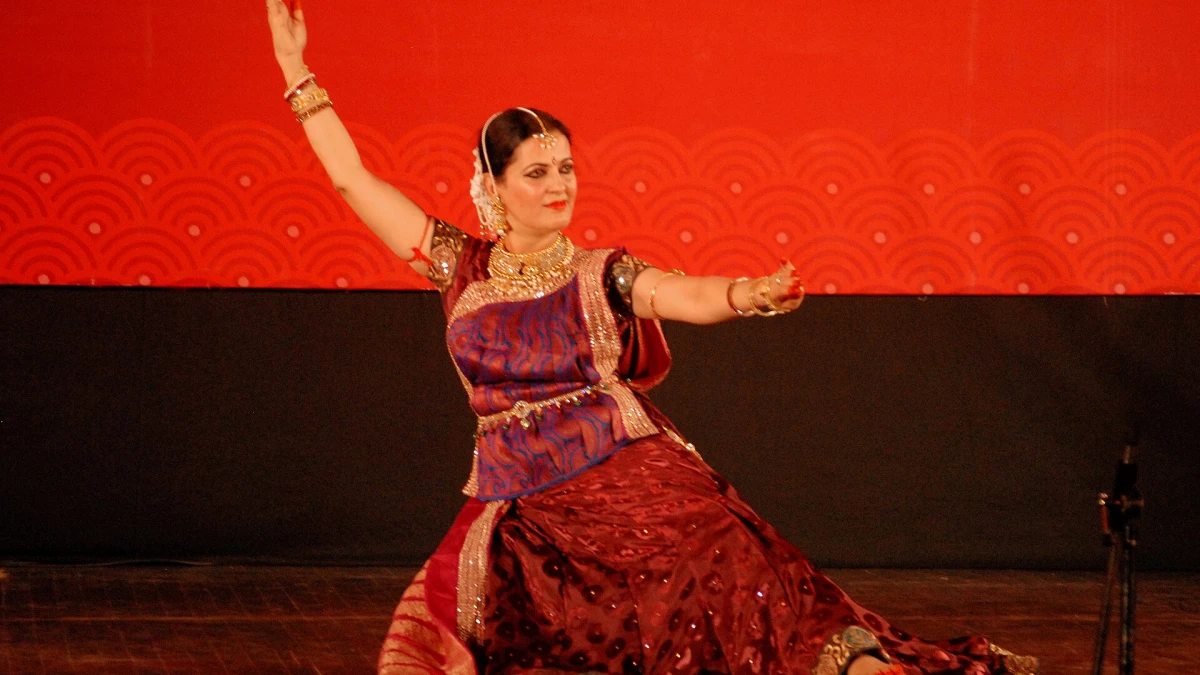
2. Jaipur Gharana: The Mastery of Rhythm and Speed
Nurtured in the royal Rajput courts of Rajasthan, the Jaipur Gharana retains warrior-like vigor and mathematical precision:
- Explosive Chakkars: Executing dozens of high-speed pirouettes (often 27 to 51 continuous spins) landing squarely on the *Sum* beat.
- Complex Layakari: Effortlessly navigating intricate fractional tempos (*Kuadi, Biadi, Paun-Gun*).
- Tandava Energetics: Vigorous footwork derived from Pakhawaj drum compositions rather than the gentler Tabla bols.
3. Banaras (Janki Prasad) Gharana: Devotional Simplicity
Founded by Janaki Prasad, this lineage preserved its sacred temple roots away from royal court glamour:
- Exclusive Use of Dance Bols: Utilizing natural foot sounds (*Natwari Bols*) rather than imitating percussion instruments.
- Floor Grounding: Emphasizing firm knee landings and flowing, steady walks (*Chalis*).
- Spiritual Themes: Deep focus on Shiva Tandava and Krishna devotion with minimal ostentation.
Which Style Do We Teach at Kailasa Kaladhara?
At Kailasa Kaladhara Bangalore, our curriculum blends the finest elements of classical Gharanas: the poetic grace and emotive abhinaya of Lucknow balanced seamlessly with the crisp footwork precision and spin stability of Jaipur.
This balanced synthesis ensures that our students graduate as complete performers—equally capable of mesmerizing audiences with soulful expression and dazzling them with rhythmic fireworks.
Frequently Asked Questions (FAQs)
Can a beginner student switch between Gharanas?
Yes. The foundational footwork (Teentaal tatkar) is shared across all traditions. Exploring distinct Gharanas enriches a dancer’s stylistic versatility.
Do costume designs differ among Gharanas?
Lucknow dancers traditionally favor flowy Anarkalis with churidars and dupattas, while Jaipur performers frequently wear flared lehenga-cholis or traditional angarkhas.
How long does it take to master high-speed Chakkars?
With correct spotting techniques and core alignment taught in our beginner batches, students develop balanced 5-to-10 spin sequences within 3 to 6 months.
Experience the Magic of Kathak in Bangalore
Immerse yourself in India’s richest storytelling dance. Contact Kailasa Kaladhara’s BTM Layout or Haralur centers to enroll in ongoing Kathak batches!













