
In Bharatanatyam, the Adavu is the foundational grammar of all movement. Just as an architect cannot build a monument on weak foundations, a dancer cannot perform complex choreographies without mastering basic adavus.
Among the traditional adavu families, Tattu Adavu (flat-foot stamping) and Nattu Adavu (heel-toe percussive strikes) form the bedrock of a dancer’s balance, rhythm, and lower-body power.
What Are Tattu and Nattu Adavus?
Tattu Adavu involves rhythmic, flat-foot strikes against the floor in the seated Aramandi posture, training foot acoustic resonance and pure timing. Nattu Adavu introduces dynamic stretches where the feet strike alternately with the heel (*Anchita*) and toe (*Kunchita*), coordinating extended arm lines with rhythmic percussive strikes.
Mastering these two foundational families builds the stamina and muscle memory required for all subsequent classical choreographies.
Step 1: Calibrating the Aramandi Posture
Before your feet strike the ground, your basic stance must be mathematically precise:
- Turn your feet outward at a 180-degree angle with heels touching or spaced 2 inches apart.
- Bend your knees sideways, ensuring knees track over the toes rather than collapsing inward.
- Keep your spine straight, ribs lifted, and pelvis tucked slightly beneath your center of gravity.
A common beginner mistake is allowing the hips to bounce up and down with each stamp. Your torso height should remain completely steady throughout the drill.
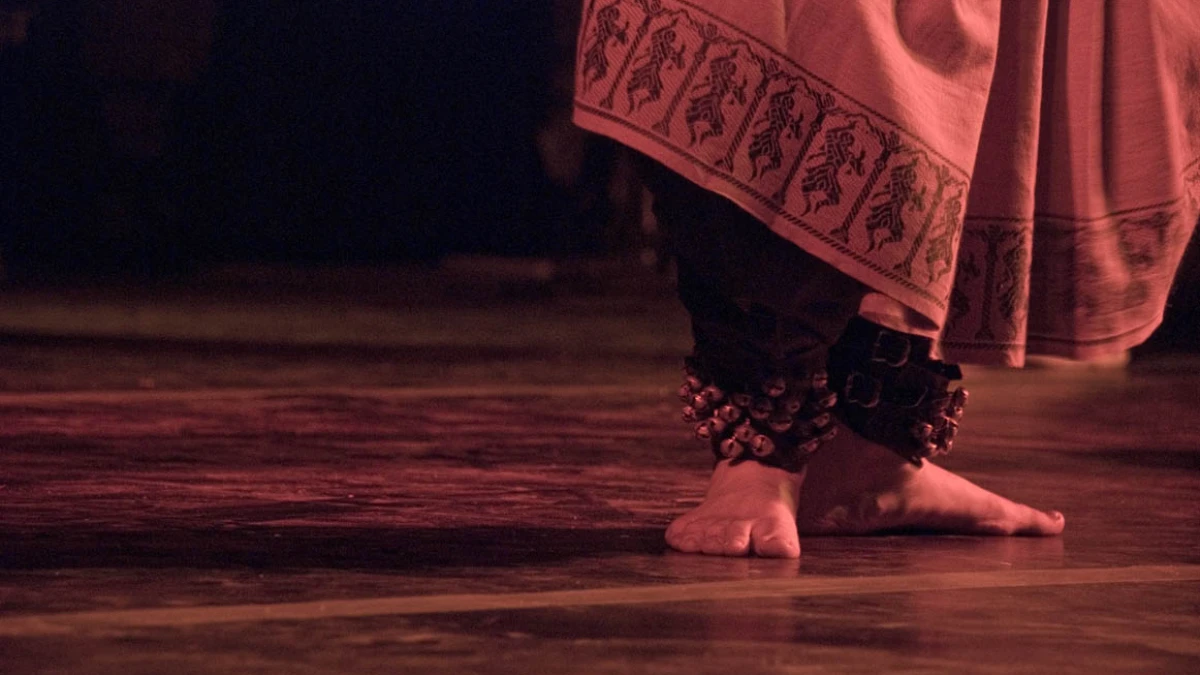
Drill 1: The Tattu Adavu Precision Routine
Tattu Adavu consists of eight distinct variations set to rhythmic solkattu syllables (*Tai-Ya-Tai-Hi*):
- Single Stamp (Speed 1): Stamp right foot firmly, then left foot, ensuring the entire sole lands simultaneously without heel lag.
- Double Stamp (Speed 2): Double tap each foot (*Tai-Tai*), maintaining equal acoustic volume on both strikes.
- Speed Transitioning (Kala Practice): Execute the full sequence in Prathama Kala (slow), double the speed into Dwitiya Kala (medium), and double again into Tritiya Kala (fast).
Drill 2: Mastering the Nattu Adavu Reach
Nattu Adavu introduces spatial extension. While your supporting leg holds a deep demi-plié, the working leg stretches outward:
- Heel Strike (Anchita): Dig the heel firmly into the floor at a 45-degree angle with toes flexed upward.
- Toe Strike (Kunchita): Retract the foot to strike on the ball of the toe directly behind the heel.
- Eye Follows Hand: As ancient Sanskrit verse dictates: “Yato Hastastato Drishtih”—where the hand goes, the eyes must follow with laser sharpness.
Essential Daily Warm-Down to Prevent Soreness
Intense adavu practice activates the quadriceps, calves, and Achilles tendons. Always conclude your practice with gentle calf stretches, ankle rotations, and lower-back hamstring folds to maintain supple, injury-free limbs.
Frequently Asked Questions (FAQs)
Why do my knees ache during beginner Aramandi practice?
Knee ache usually indicates that knees are collapsing forward rather than opening sideways. Practice against a wall to verify proper external hip rotation.
How many minutes should a beginner spend on adavu drills daily?
Spending 20 to 25 focused minutes on adavu drills daily produces dramatic improvements in foot clarity and stamina within 30 days.
Should adavus be practiced on marble, tile, or wooden flooring?
Whenever possible, practice on wooden, sprung, or smooth clay flooring. Avoid stamping forcefully on concrete or hard tile without warm-up mats.
Train Under Experienced Masters at Kailasa Kaladhara
Refine your footwork technique with personalized corrections from certified faculty. Book a trial session at your nearest KKD Bangalore branch!













